
On 30 July 2026, bitcoin began being drained from wallets whose owners had done everything right. The coins sat behind Coldcard hardware wallets: air-gapped devices, keys generated offline, no exchange dependency, no counterparty. Twenty-five minutes into the first sweep, roughly 594 BTC, close to USD 38 million at the time, had moved out of about 500 wallets into a single consolidation address. Three further waves followed over four days. As of this writing, Galaxy Research’s running tally stands near 1,816 BTC, close to USD 116 million, drained from more than 5,200 addresses, and the analysts tracking it caution the figure is preliminary. It is already the third-largest crypto theft of 2026, a year that has now passed USD 1.2 billion in losses across 276 incidents.
The uncomfortable detail is not the size. It is that the attackers never touched a single device. The keys were guessable from the day they were generated, and had been for five years.
Figures and technical findings are as of 14 August 2026 and draw on Coinkite’s advisory, Block’s engineering analysis, and TRM Labs’ on-chain assessment. Loss tallies are preliminary and likely to rise as victims surface.
The flaw: randomness that wasn’t so random
The strength of every Bitcoin wallet reduces to one thing: the randomness of the number that created it. A 12-word seed phrase is supposed to encode 128 bits of entropy, a space so large that guessing is practically impossible. Everything else, the steel plates, the air gap, the tamper-evident bags, protects that number after creation. None of it can help if the number was predictable at creation.
That is what went wrong. In March 2021, firmware version 4.0.0 changed how Coldcard devices generated seeds. Through a chain of small, individually reasonable engineering decisions, reconstructed in public by Block’s engineering and security teams, seed generation silently fell back to a software pseudo-random generator seeded from predictable values: the device’s fixed hardware identifier and its internal timers. The hardware entropy chip, the component whose entire job is true randomness, was no longer being triggered.
The failure passed testing for five years because the safeguard meant to catch it checked that a configuration setting existed rather than that it was switched on. A health check on the output saw numbers that passed its tests, because a deterministic generator produces numbers that look random. They are not: they are a fixed sequence, and anyone who can reconstruct the starting conditions can reproduce every one of them.
The consequences differed by generation of device:
| Device and firmware at seed generation | Effective exposure |
|---|---|
| Mk2 / Mk3, firmware v4.0.0 to v4.1.9 | Severe. No cryptographic entropy in the path. With known device and timing values, seed generation is deterministic, with a broad upper bound near 40 bits |
| Mk4 / Mk5 / Q, production firmware | Weakened. Secure-element entropy is mixed in but only 32 bits of it are retained, a fraction of the intended strength |
| Any device, seeds from v3.2.2 or earlier (pre-March 2021) | Outside the regression. The hardware generator was used directly |
| Tapsigner, Opendime, Satscard | Unaffected |
Forty bits is a search space a well-resourced attacker can enumerate offline. Every funded address whose public key is visible becomes an oracle: generate candidate seeds, derive addresses, and collect matches. No device access, no malware, no phishing. The victims made no operational mistake at all.
Two groups fared better, and the reason matters later in this argument. Users who added their own entropy at setup, 50 or more physical dice rolls, and users who protected their wallet with a passphrase, face materially lower risk. Their security did not depend on a single implementation doing its job.
Coinkite disclosed the flaw the day the sweeps began, published fixed firmware for every affected model, and told anyone whose seed was generated in the window to treat it as compromised and migrate. That response deserves to be recorded plainly: rapid, technically transparent, and echoed by independent researchers working the same problem in public. This article draws no conclusions about one vendor. It draws conclusions about the architecture, because the flaw’s structure, a silent fallback, an ineffective safeguard, five quiet years, is not unique to any company. It is what complex software does.
Why the air gap did not matter
The self-custody security model concentrates on physical and network isolation: keep the keys off any connected machine, sign offline, verify on the device. The Coldcard exploit defeated none of those controls. It did not need to. The attack ran entirely on the attackers’ own hardware, against mathematics rather than infrastructure.
That is the first structural lesson. An air gap protects a secret from exfiltration. It cannot make a weak secret strong. A wallet is only as trustworthy as the process that generated its key, which makes how keys are generated, where firmware comes from and how it is built, and how much the implementations behind an arrangement differ as much a part of custody due diligence as vault doors and background checks. Those properties are invisible to the holder. There is no way to look at twelve words and know whether the process behind them was sound. Trust in a single implementation is exactly that: trust, unverifiable from the outside, held against a class of failure that stays silent until it is catastrophic.
The wrong lesson: trading one single point of failure for another
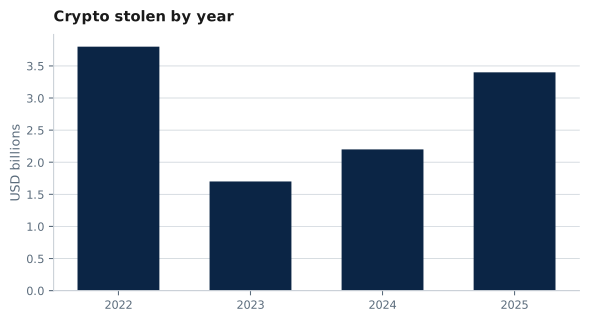
The observable market reaction to the exploit has been migration: holders moving coins out of hardware wallets and onto exchanges and custodial platforms, and some selling their bitcoin outright, on the reasoning that a professional balance sheet must be safer than a device. The reasoning fails on the record. Platform custody concentrates keys and processes inside one organisation, and that concentration has produced the industry’s dominant loss category for a decade:
| Year | Crypto stolen (USD, Chainalysis) |
|---|---|
| 2022 | ~$3.8 billion (prior peak) |
| 2023 | ~$1.7 billion |
| 2024 | ~$2.2 billion |
| 2025 | over $3.4 billion (highest since 2022, below the 2022 peak) |
To that theft record add the legal one: the largest US-listed custodian discloses in its own filings that custodially held crypto could, in its bankruptcy, be treated as property of the estate, with customers as unsecured creditors. The Celsius and Prime Trust insolvencies made that risk precedent rather than theory.
In a custodian’s bankruptcy, “custodied” can legally mean “unsecured creditor.” A holder who moves coins from a compromised seed to a single custodian has not eliminated their single point of failure. They have relocated it, from an implementation they could not audit to an institution they cannot audit either, and whose failure modes, breach, insolvency, seizure, freeze, have a longer and larger record than firmware bugs.
TRM Labs, tracing the stolen Coldcard funds, put the general point precisely: self-custody relocates risk rather than eliminating it. The honest completion of that sentence is that platform custody does the same. Every arrangement that reduces to one secret, one implementation, or one institution carries the same problem. The variants differ only in where it surfaces.
The right lesson: containment, not avoidance
The useful question is not “which single point of failure is safest,” because the answer changes with every incident. The useful question is which custody arrangements survive the failure of any single component, because components fail. Firmware regresses. Institutions break. Insiders defect. The design goal is an arrangement where any one failure is an incident report rather than a loss.
That is what a quorum of independent keys does. In a 2-of-3 multi-institution arrangement, where three keys are held by three separate institutions and every movement of funds requires two signatures enforced by the Bitcoin protocol itself, a flaw like July’s in one key holder’s implementation compromises one key. None of the three institutions generates keys on a retail device. Each runs its own independent stack, so no two keys share an origin. The attacker who recovers that key can sign nothing alone. The surviving quorum migrates the funds to fresh keys on its own schedule, and the client loses nothing. The same containment logic covers the other single-component failures: one institution’s insolvency, one seizure order, one breach, one operational collapse. The quorum routes around each.
One qualification carries the whole argument, and it comes from the exploit’s own analysts. Block’s report is explicit that a multisig composed exclusively of vulnerable devices remains exposed: if all three keys were generated by the same flawed implementation, all three fall to the same attack. Multiplicity without independence is decoration. The containment comes from diversity: keys generated by independently designed systems, on independently operated infrastructure, held by institutions that share no implementation, no premises and no balance sheet. This is the same principle that saved the dice-roll and passphrase users, promoted from an operator’s habit to an architectural property, so that it no longer depends on any individual doing something unusual at setup.
Multi-institution custody is that principle applied at institutional grade: independent institutions in independent jurisdictions, each generating and guarding its own key under its own controls, with the quorum rule enforced on-chain rather than by policy. The full architecture, including how recovery works when a key holder fails permanently, is set out on our custody architecture page, and the broader comparison of custody models is scored in How to hold Bitcoin.
What this means for an institution
For a fiduciary, the Coldcard incident is a clean case study in why custody due diligence has to interrogate properties that are invisible at the point of use. Three questions fall out of it directly:
- Where was every key generated? Not which device holds it now, but what implementation generated it, and whether any two keys in the arrangement share that origin. After July 2026, “all keys were generated on the same vendor’s stack” is a finding, not a footnote.
- What single failure moves the assets? If the honest answer is any one thing, one seed, one HSM, one institution, one jurisdiction, the arrangement has a single point of failure, whatever its marketing says. The exchange answer and the hardware-wallet answer differ less than either admits.
- What is the recovery path when a component breaks? The measure of a custody design is not whether components fail but what the failure costs. In a quorum arrangement, the cost of the Coldcard exploit would have been a scheduled key rotation. Outside one, it was total.
The regional dimension is worth stating once, plainly. Institutional holders in the Gulf have historically faced a choice between operational self-custody, with its silent implementation risks, and offshore platforms, with their concentration and jurisdictional distance. A supervised, quorum-based custody layer inside the region’s own regulatory perimeter is the structural answer to both, which is the problem Onramp MENA is being built to address, under a Central Bank of Bahrain licence application now in preparation.
The exploit will be remembered as a hardware wallet story. It is better understood as the strongest recent evidence for a very expensive design rule the industry keeps relearning: the question is never whether a component can fail. It is whether the arrangement survives when it does.
References
- Coinkite, Coldcard Security Advisory: Mk3 seed generation warning, 30 July 2026
- Block Bitcoin Engineering and Security, Predictable RNG Fallback and 32-Bit Reseed in COLDCARD Firmware, 30 July 2026
- TRM Labs, Inside the USD 116 Million Coldcard Hack, 5 August 2026 (incorporating Galaxy Research’s running loss tally)
- TechCrunch, Hackers steal over $130M by exploiting bug in offline hardware wallets, 4 August 2026
- Bloomberg, Hackers target bitcoin’s safest hiding place in ongoing attack, 3 August 2026
- Chainalysis crypto theft by year, as compiled in How to hold Bitcoin
Frequently asked questions
What caused the Coldcard hack?
A build configuration error introduced in firmware version 4.0.0 (March 2021) caused seed generation to fall back to a deterministic software random number generator, seeded from predictable values such as the device identifier and internal timers, instead of the hardware entropy chip. A safeguard failed to catch it because it checked that a setting existed rather than that it was switched on. Keys generated on affected firmware were weak enough to be brute-forced offline, without physical access to the device.
Which Coldcard devices are affected?
Per Coinkite and independent analysis by Block engineering: Mk2 and Mk3 devices whose seeds were generated on firmware v4.0.0 through v4.1.9 are the most severely affected. Mk4, Mk5 and Q devices mix in secure-element entropy but retain only 32 bits of it, a material weakening. Seeds generated before March 2021 (firmware v3.2.2 and earlier) used the hardware generator directly and are outside the regression, as are Tapsigner, Opendime and Satscard. What matters is the firmware at the moment the seed was generated, not the device's age or its current firmware.
Does updating Coldcard firmware fix the vulnerability?
No. A firmware update fixes future seed generation only. A seed generated on vulnerable firmware remains weak forever, on any device it is moved to. Coinkite's guidance is to generate a brand-new seed on fixed firmware and migrate funds, beginning with a small test transaction. Users who added 50 or more dice rolls at setup, or who use a passphrase, face materially lower risk.
Is self-custody dead after the Coldcard exploit?
No. The exploit is not an argument against self-custody. It is an argument against single points of failure. Moving coins from a hardware wallet to an exchange or a single custodian replaces a guessable seed with a different single dependency that has a worse historical loss record. The structural lesson is that any custody arrangement resting on one secret, one implementation, or one institution fails totally when that one thing fails.
Would a multisig setup have survived the Coldcard exploit?
Only if its keys were independent. Block engineering's analysis is explicit that a multisig composed exclusively of vulnerable devices remains exposed, because every key inherits the same flaw. A quorum whose keys are generated by independent implementations, held by independent parties, turns the same exploit into a contained incident: one compromised key cannot move funds, and the surviving quorum migrates them safely. Independence, not multiplicity alone, is the active ingredient.
This article is published as research and analysis. It does not constitute legal, regulatory, financial, or investment advice and should not be relied upon in connection with any specific transaction or licensing strategy. Readers should seek their own qualified counsel. Where specific products, providers or jurisdictions are named, they are referenced factually on the basis of public information, for analysis, and not as endorsements.