
The monetary order is fragmenting, and capital is looking for a hedge. For the allocator the live question is no longer whether to hold a non-sovereign reserve but which one. That framing contains a mistake. Gold and bitcoin are usually discussed as rival answers to the same question. They are better understood as instruments built for different problems.
Gold is the defensive holding. It did the safe-haven work through the stress of early 2026, it is the asset that de-dollarising central banks are accumulating, and at the end of 2025 it passed US Treasuries as a share of official reserves for the first time in decades. Bitcoin is the asymmetric one. It is superior on portability, divisibility and fixed supply, and its volatility has fallen materially, but it still trades like a risk asset rather than a haven, and no central bank yet holds it as a monetary reserve.
The posture the evidence supports is a barbell of the two, weighted to conviction and to how much tail risk a mandate can carry. The fragmentation thesis is sound, but what it describes is a slow erosion of dollar primacy with no successor in place, not a collapse. Gold has been the readier beneficiary so far, and bitcoin the longer-dated position whose case as a reserve asset is unproven rather than refuted. For a long-horizon institution the operative question is less whether to hold bitcoin than how to hold it safely, which turns on custody rather than on the macro view.
| Metric | Value |
|---|---|
| Gold’s share of official reserves, end-2025 | 27% (ahead of US Treasuries at 22%) |
| USD share of global FX reserves, mid-2025 | 56.3% (from about 72% in 2001) |
| Bitcoin over the year to June 2026 | −40% (gold +26% over the same window) |
| Bitcoin six-month realised volatility | about 30%, a record low (from about 60%) |
Fragmentation is real, and slower than it looks
The direction of travel is not in dispute. The dollar’s share of allocated global reserves has fallen to about 56.3% by mid-2025 (IMF COFER), well below its 2001 peak near 72%. The drivers are familiar: the freezing of Russian reserves in 2022 and the precedent it set, a 2026 tariff regime that BRICS members have formally called economic coercion, and the gradual build-out of payment infrastructure that routes around the dollar. China’s CIPS network now spans more than 100 countries through over 1,600 participants, and Beijing has reduced its reported Treasury holdings by about a third since the end of 2021, to a seventeen-year low.
Figure 1. The dollar’s relative decline. USD share of allocated global FX reserves (IMF COFER, methodology breaks near 2014 and Q3 2025).
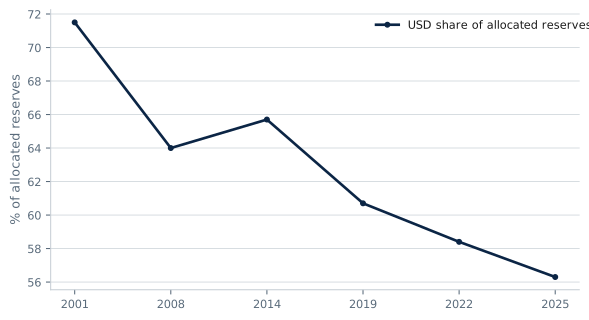
| Year | USD share of allocated reserves |
|---|---|
| 2001 | 71.5% |
| 2008 | 64.0% |
| 2014 | 65.7% |
| 2019 | 60.7% |
| 2022 | 58.4% |
| 2025 | 56.3% |
A reign in its late stage
It helps to be precise about which version of the “empires fall” idea is doing the work. Sir John Glubb’s 1976 figure of roughly 250 years for the average great power is too loose to set a clock by, and the regularity is partly imposed in hindsight. Ray Dalio’s account is narrower and more useful. In his reading, reserve-currency status passed from the Dutch guilder to the British pound to the US dollar in long cycles that decay as debt accumulates, military commitments outrun resources, and a rival gains. By that measure the dollar’s reign, about eighty years old, sits late in its cycle, with both rising debt and a peer competitor pointing the same way.
Late in a cycle is not the same as close to its end. In the places that matter most the dollar remains entrenched, and on some measures it is gaining. It is on one side of roughly 89% of foreign-exchange trades and about 48% of SWIFT payment value. The renminbi cannot replace it while China maintains a closed capital account, and the last transition is a caution against expecting a quick one: sterling took four to five decades to fall from around 60% of reserves in 1913 to a small, secondary share. For an allocator the relevant point is that this is a durable rotation away from concentrated dollar exposure rather than a collapse, and that is the environment in which a non-sovereign hedge earns its place.
A slow rotation with no successor in place favours a diversifying hedge held alongside the dollar system, rather than a single asset that replaces it. Everything that follows is read in that light.
Gold: the reserve of the multipolar hedge
The milestone itself is real. The European Central Bank’s June 2026 report on the international role of the euro recorded that gold made up 27% of total official reserves (foreign exchange plus gold) at the end of 2025, ahead of US Treasuries at 22% and the euro at 15%. It is the first time in decades that gold has been the larger of gold and Treasuries.
Two qualifications keep the figure in proportion. Most of the move is valuation rather than buying: gold rose about 60% in 2025, which lifts its share of the reserve pool even if no central bank adds an ounce. The ECB makes the point itself: valued at end-2023 gold prices, gold and the euro would each sit near 16% and US Treasuries markedly higher at 26%. And the dollar system as a whole still dominates, with dollar-denominated assets the largest single component of reserves at roughly 42%. Gold passing Treasuries is both true and significant. It is not the same thing as the dollar being displaced, and the two statements sit together comfortably.
Figure 2. Gold overtakes Treasuries in official reserves. Share of global official reserves by market value (ECB, June 2026). The shift is largely valuation-driven.
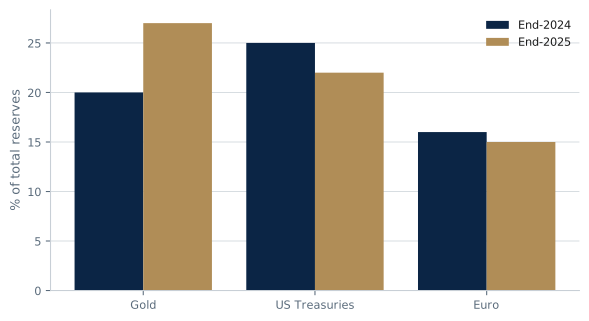
| Reserve component | End-2024 | End-2025 |
|---|---|---|
| Gold | 20% | 27% |
| US Treasuries | 25% | 22% |
| Euro | 16% | 15% |
The flows are real as well, if slower. Central banks now hold more than 36,000 tonnes of gold, close to the Bretton Woods peak, after net purchases above 1,000 tonnes in each of 2022, 2023 and 2024. Buying slowed to about 863 tonnes in 2025, which the bears reasonably note. China remains the conviction buyer. The People’s Bank extended its run to nineteen consecutive months through May 2026, reaching about 2,332 tonnes, and it kept buying while gold traded well above $3,000 and later above $4,000.
The thesis, reframed against today’s price
Any discussion of an extreme gold target has to begin from the current price, which is no longer $2,000. Gold set an all-time high of $5,589 on 28 January 2026, then corrected sharply, and traded near $4,200 on 12 June 2026. It closed 2025 around $4,200, a gain of about 60% on the year, after a run of record highs. Measured from there, a target of $30,000 to $40,000 is a move of roughly seven to nine times, where two years ago it would have been fifteen. The figure is still very large, but it is a different proposition.
It also sits well above any mainstream forecast. The strongest form of the bull case rests on a backing calculation. Divide a US monetary aggregate by official US gold holdings of 8,133.5 tonnes, about 261.5 million ounces, and the result is the gold price at which existing reserves would fully cover that aggregate.
Figure 3. What it would take for gold to “back” US money. Implied USD/oz at which US official gold (8,133.5t) fully backs each aggregate.
| Aggregate | Implied gold price (USD/oz) |
|---|---|
| Spot, 12 Jun 2026 | about $4,186 |
| Monetary base (about $5.4T) | about $20,604 |
| M2 money supply (about $22.8T) | about $87,206 |
| Federal debt (about $39.2T) | about $149,904 |
Within a hard-money frame the target is not outlandish. It falls between fully backing the monetary base, at about $20,600, and backing roughly 40% of M2, at about $87,200. This is the range cited in the kind of monetary “re-anchoring” scenario the ECB itself referenced. It describes a change of monetary regime rather than a forecast, and is worth treating as such. For calibration, mainstream desks sit far below it, clustered around $5,400 to $6,000 for end-2026 (Société Générale $6,000, JPMorgan guiding toward $6,000, UBS $5,500 after a May cut, Goldman Sachs $5,400).
The bear case is not hypothetical. It is the current tape. Gold fell from about $5,500 to $4,200 as the macro backdrop turned against it. US producer prices rose 6.5% year-on-year in May 2026, CPI reached 4.2%, the highest reading since 2023, and the ECB raised rates on 11 June for the first time since 2023. Higher real rates are the classic headwind for an asset that yields nothing. The same inflation and conflict that underpin the long-run thesis are, for now, producing the rate response that weighs on the price. A reserve lead built on valuation can also unwind if bullion falls, a point the ECB makes itself.
The suppression question, handled with discipline
The claim that gold’s price is “suppressed” tends to compress a real spectrum into a single settled fact. It is worth separating what is documented from what is contested, since the two are often presented together.
The documented part is not fringe. The London Gold Pool of 1961 to 1968 was an openly acknowledged arrangement among eight central banks to hold gold at $35. It operated, and it failed. Central banks leased gold through the 1990s and 2000s, with the United Kingdom’s sales near the 1999 to 2002 low the best-known episode. And manipulation has been prosecuted: JP Morgan paid about $920 million in 2020 to settle US charges of spoofing in precious-metals futures, and other banks were fined.
The contested part is the stronger claim of a coordinated, decades-long suppression scheme on the brink of a delivery failure and a sudden revaluation. The figures usually cited for it, such as a 109-to-1 ratio of paper claims to physical metal, trace mostly to advocacy sources and do not hold up well. Above-ground gold is worth closer to $28 to 30 trillion today, and the leverage point reflects how futures markets generally work, with under 1% of contracts settled by delivery.
The reasonable version of the price-discovery argument is already playing out. Steady physical demand from central banks and from Asian buyers is repricing gold upward, and the metal is moving into hands that are unlikely to sell. The dramatic version, an imminent exchange delivery failure that forces a tenfold revaluation overnight, has been forecast for fifteen years without arriving. The structural story is the one the evidence supports.
Bitcoin: the convex bet, rails today and reserve maybe
Start with the episode that most directly tests the “digital gold” thesis. The stress of early 2026, with high inflation, an active war and broad monetary anxiety, was the scenario in which bitcoin was meant to behave like a safe haven. It did the opposite, falling about 40% over the year to June 2026, from roughly $107,000 to $63,458, while gold rose about 26%. The Crypto Fear and Greed Index sat in “extreme fear,” and the decline coincided with institutional ETF outflows and a wider drain of liquidity from risk assets. Two assets that the maximalist case treats as one trade came apart, and they came apart at the moment a reserve is supposed to hold.
Figure 4. The decoupling. Bitcoin versus gold, indexed to 100 at June 2025 (month-end).
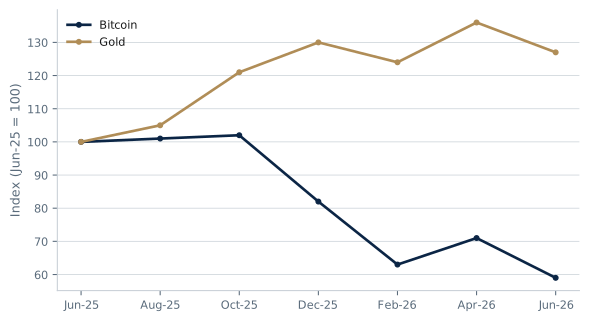
| Month | Bitcoin (index) | Gold (index) |
|---|---|---|
| Jun-2025 | 100 | 100 |
| Aug-2025 | 101 | 105 |
| Oct-2025 | 102 | 121 |
| Dec-2025 | 82 | 130 |
| Feb-2026 | 63 | 124 |
| Apr-2026 | 71 | 136 |
| Jun-2026 | 59 | 127 |
None of this denies bitcoin’s advantages, which are real. It is more portable, more divisible, easier to verify and more strictly scarce than gold. On the hardness measure the bull case favours it has already passed gold: after the 2024 halving its stock-to-flow ratio (the existing stock divided by annual new supply, a measure of hardness) is near 118 against gold’s 56 to 62, and the 2028 halving will roughly double it again. The mistake is to treat “better money” and “better reserve” as the same test. The job of a reserve is to hold its value when little else does, and that is the test gold still wins today.
Volatility is falling, and that matters
The strongest argument for bitcoin’s maturation is that volatility is not a fixed property. It is a function of market depth, and it has been falling. The data bears this out. JP Morgan finds that six-month realised volatility dropped from nearly 60% at the start of 2025 to about 30%, the lowest on record, and NYDIG puts the bitcoin-to-gold volatility ratio at roughly 3.6 times and narrowing. Gold offers a precedent: its own volatility spiked after the 1971 break with the dollar and then settled as it matured into an established asset class. JP Morgan has even put a figure on the endpoint, a scenario worth roughly $266,000 a coin if bitcoin came to behave like gold on a risk-adjusted basis.
This is a real concession, and it disposes of the simple objection that volatility alone rules bitcoin out. It moves the disagreement rather than ending it. Falling average volatility and reserve-grade behaviour in a crisis are different things, and only the second defines a reserve. The same institutional adoption that compressed average volatility has also tied bitcoin more closely to the global liquidity cycle, which is why it still sells off hardest when a reserve is most needed, as the year demonstrated. Average volatility is converging on gold’s. Behaviour in the left tail has not.
Payment rails are not reserves
Much of the strongest evidence for bitcoin in a fragmenting world is really evidence about payment rails rather than reserves. The clearest current example is Iran. Through early 2026 the Revolutionary Guard has been extracting transit tolls from vessels in the Strait of Hormuz, reported at roughly $1 a barrel and payable in Chinese yuan or stablecoins through an IRGC-linked permit system (Bloomberg, 1 April 2026). If the crypto leg is borne out, it would be the first known instance of a state demanding digital-currency payment for passage through a major waterway, though analysts caution that the exact payment rails are still being established.
The detail matters, though. Iran accepts bitcoin, dollar stablecoins and Chinese yuan, and analysts tracking the flows believe stablecoins carry most of the value, with the yuan leg routed through Kunlun Bank over CIPS. Being paid a toll in bitcoin and converting it is not the same as holding bitcoin as a strategic reserve. The case for censorship-resistant rails is being won. It does not by itself establish the case for bitcoin as a reserve, and even on the rails bitcoin trails stablecoins and the yuan.
Bitcoin weakens capital controls, which is the main reason most governments are wary of encouraging it. A sanctioned state may reach for it defensively while continuing to build instruments it can control for everyone else: central-bank digital currencies, the yuan over CIPS, regulated dollar stablecoins, and gold held in its own vault. That points to limited adoption by cornered states, not broad adoption as a reserve.
There is an irony here that should trouble both maximalist camps. The dominant money inside crypto is not bitcoin but dollar stablecoins, and US policy is deliberately extending the dollar onto crypto rails. Yet stablecoins fail as a sovereign anti-confiscation reserve for the very reason a hard-money advocate would predict. On 23 to 24 April 2026 Tether froze about $344 million of USDT across two addresses tied to Iran’s central bank, at the US Treasury’s request, at the level of the token contract itself. A stablecoin reserve is a dollar reserve with an added layer of counterparty risk. That failure strengthens the narrow case for a genuinely unconfiscatable bearer asset, which points back to bitcoin and to physical gold.
Tail risks that lower volatility does not address
Over a fifteen-to-twenty-year horizon, three structural risks matter more than price volatility, and none of them eases as bitcoin matures.
The first is quantum computing. A Google Quantum AI paper in March 2026 argued that breaking bitcoin’s elliptic-curve cryptography might require fewer than 500,000 physical qubits, well below the millions once assumed. Roughly a quarter to two-fifths of all bitcoin, about 6.9 million coins including some 1.7 million from the Satoshi era, sits in addresses whose public keys are already visible on-chain. The threat is not near-term. Grayscale calls it a red herring for now, and a capable machine is widely thought unlikely before about 2030. But it is structural, and bitcoin is more exposed than the banking system for a specific reason. A bank’s vulnerable keys are private and can be rotated, and it can patch on a regulator’s deadline. Bitcoin’s exposed keys are public and permanent, its governance is slow and contested, and a coin taken this way is gone with no recourse. The feature that makes it a strong store of value, that no one can change it, becomes a liability on the day it has to change.
The second is the security budget. Miner revenue is shifting from the block subsidy, which halves toward zero by the 2040s, to transaction fees alone, and whether fees can secure a settlement network worth trillions is an open question over that span. The third is survivorship. On the historical record gold is all but certain to still be a monetary asset in twenty years. Bitcoin’s odds are high but not certain, and the asymmetry is what counts: gold disappointing costs an opportunity, while bitcoin failing can cost the principal.
Self-custody gold and self-custody bitcoin insure against different worlds
Set aside the derivatives that neither side should count. Tokenised gold and gold ETFs can be frozen in the same way the USDT was frozen in April, and a bitcoin ETF or an exchange balance is likewise a claim on a custodian. The honest comparison is a coin in your own hand against keys only you control. Narrowing to that does not produce a winner. It shows that the two are built for different kinds of failure.
| Property | Self‑custody gold | Self‑custody bitcoin |
|---|---|---|
| Portability across a border | Low (heavy, seizable in transit) | High (a memorised seed) |
| Divisibility | Coarse | Near‑infinite |
| Verifiability | Assay required | Cryptographic proof |
| New supply | about 1.5% per year | Fixed 21M cap |
| Track record as money | about 5,000 years | about 16 years |
| Technological dependency | None | Network, power, intact cryptography |
| Custody failure mode | Physical, partial, forgiving | Irreversible, total, unforgiving |
| Liquidity in a regional crisis | High once across a border | Needs connectivity, often the thing cut |
The decisive point is that the typical crisis is neither a world that works normally nor a collapse of civilisation. It is the large middle ground in which the global system keeps running while one country is cut off from it, and that middle ground is recorded hundreds of times a year. Government internet shutdowns reached a record 313 across 52 countries in 2025, up from 78 in 2016, and they cluster where a hard asset is most useful: conflict has been the leading cause for three years running.
In that middle ground the two assets complement each other rather than compete. At the border bitcoin has the edge, since a memorised seed phrase crosses where gold would be seized. Moving it, though, requires connectivity, which is exactly what a government tends to cut. Gold cannot be carried in your head and can be taken in transit, but once it is across it is liquid into a working global market with no network at all. Neither is strictly better. Bitcoin protects against debasement and capital controls in a world that keeps functioning. Gold protects against debasement, and against your part of the world ceasing to function.
Trust, cost of living, and the generational tailwind
The motive is real and measurable. The 2026 Edelman Trust Barometer found trust sliding into what it called insularity, with roughly a third of respondents expecting the next generation to be better off and government the least trusted of the major institutions. The pattern among younger investors echoes it: a cohort that feels it has fallen behind on the conventional path is readier to look outside the system for a store of value. This is a durable source of demand for a monetary refuge, and a route to acceptance that builds from the household up rather than from the state down.
Figure 5. A digital-native demand base. Crypto ownership by generation, share of US adults (Security.org, January 2026). Younger cohorts lead. The fall to older ones is the signal.
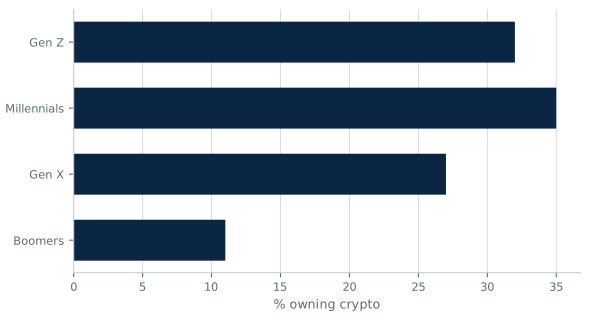
| Generation | Owning crypto |
|---|---|
| Gen Z | 32% |
| Millennials | 35% |
| Gen X | 27% |
| Boomers | 11% |
Two cautions keep this from becoming a bitcoin-only story. Anxious, safety-seeking demand has always been gold’s territory as much as bitcoin’s. Gallup’s 2025 poll already ranks gold as Americans’ second-favourite long-term investment, ahead of equities for the first time in over a decade. And being a digital native predicts comfort with digital assets as a category, including tokenised gold and stablecoins, not with bitcoin in particular. The likelier outcome is a larger total pool of non-sovereign money, with bitcoin taking more of the Western, risk-tolerant share and gold holding the crisis-haven and Asian core. The generation the bull case relies on is hedging across both.
The reading: ballast and convexity
The analysis keeps arriving at the same place. Ranking gold against bitcoin on return or scarcity is the wrong frame. On those measures bitcoin wins, clearly on past return and structurally on hardness. Those measures say nothing about what gold provides, which is robustness and insurance in the bad states of the world. No single number ranks the two, because they are built for different purposes. For scale: above-ground gold is worth roughly $29 trillion, bitcoin about $1.3 trillion, and dollar stablecoins about $0.32 trillion. Bitcoin remains a fraction of gold by market value, which limits the scale of an allocation today, not its trajectory.
The reading follows from that. Gold is the defensive holding: proven, low in tail risk, the asset that works when it is most needed and the one de-dollarising central banks are buying. Bitcoin is the asymmetric holding, with greater upside if the new-money thesis matures and larger, less familiar tail risks if it does not. The defensible form of the bull case is not that bitcoin replaces gold because it is the superior technology. It is that an allocator can hold exposure to the chance that a superior monetary technology wins while still holding the asset that protects the portfolio if it does not.
Sizing the barbell
What does “weighted to conviction and tail risk” mean as a number? No single figure can be prescribed, because the right weight depends on a holder’s mandate, horizon and liquidity, but the discipline is straightforward. Gold is the larger, defensive weight: it can be meaningful without threatening the portfolio, because its drawdowns are shallow and its job is to work when other assets do not. Bitcoin is the smaller, convex sleeve, and the cleanest way to size it is by the loss it could impose, not the return it might deliver. The asset has fallen more than 75% twice in its history, so a prudent holder sizes it such that even an 80% drawdown costs no more than the portfolio can comfortably absorb. On that arithmetic a 2% sleeve caps the loss at roughly 1.6 points of the portfolio and a 5% sleeve at about 4. Most mandates that can hold a fifteen-to-twenty-year position can carry something in that range, and few should carry much more until bitcoin behaves like a haven through a real liquidity shock.
Two corollaries follow. The weights are not symmetric: gold disappointing costs an opportunity, while bitcoin failing can cost the sleeve, so the bitcoin weight should be one the holder is genuinely prepared to lose in full. And the position has to be rebalanced. Left alone, a small sleeve that performs becomes a large, unintended bet on the most volatile asset in the book, so trimming it back to target is what turns volatility from a threat into a source of return. None of this is advice for a particular holder. It is the frame within which a holder sets a number.
The most useful signal over a fifteen-to-twenty-year horizon is not the headline volatility figure. It is whether bitcoin begins to hold up during liquidity shocks, behaving like a haven rather than like leveraged technology. The first serious risk-off event it weathers the way gold did in early 2026 will be the real sign that its maturation is completing.
For the GCC and APAC allocator the shared rationale for both assets is diversification against confiscation: gold in a sovereign’s own vault and self-custodied keys both sit outside the reach of a foreign freeze, and both reward control of the asset itself over a claim on a custodian. That property is also what makes the safekeeping of a bearer holding part of the position rather than an afterthought, and it matters most for bitcoin. The operational risks discussed above are largely properties of self-custody rather than of the asset itself: a lost key, a coerced disclosure, a public key left exposed to a future quantum attack. Distributing signing authority across several independent institutions, so that no single key and no single failure can move the holding, is what turns those risks from catastrophic into managed, and it is the practical difference between a convex bet and a position an institution can hold for twenty years. The question for an allocator is therefore less whether bitcoin can be held to an institutional standard than how, which is a matter of custody design rather than of the macro view set out here, and which the companion piece, How to hold Bitcoin, takes up in detail.
Bitcoin protects against debasement and capital controls in a world that keeps working. Gold protects against debasement, and against the world not working. Holding both is the honest response to not knowing which arrives.
Outlook
The fragmentation trade should deepen on the timetable history tends to impose, measured in decades rather than headlines, with gold remaining the main beneficiary at the sovereign level while bitcoin’s case as a reserve is tested in real time. The probabilities run roughly as follows. Continued, gradual diversification of reserves into gold is the highest-conviction call. Defensive bitcoin holdings by a handful of sanctioned or peripheral states are plausible and perhaps likely. Broad adoption of bitcoin as a sovereign reserve remains a tail outcome that would require the dollar system to fracture rather than merely erode.
A private institution, though, is not a central bank, and the test it faces is the lower one. A family office or a corporate treasury can hold a volatile, long-dated position that a central bank’s mandate would not permit, so for that holder the live question is less whether bitcoin becomes a global reserve than whether a measured allocation earns its place over a fifteen-to-twenty-year horizon. On that test the case is already credible. The Gulf allocator is unusually well placed to weigh it: the region pairs a deep affinity for gold with sovereign-scale balance sheets and a regulatory build-out, in Bahrain and across the wider GCC, that is bringing institutional-grade digital-asset custody within reach at home rather than offshore.
None of this argues for a zero weight in either asset. The posture consistent with the evidence is to size the asymmetric position to conviction, hold the defensive one regardless, secure both to an institutional standard, and watch how bitcoin behaves in the next liquidity shock rather than the next headline.
References
- European Central Bank, The international role of the euro, June 2026.
- World Gold Council, Gold Demand Trends, Full Year 2025, January 2026.
- International Monetary Fund, Currency Composition of Official Foreign Exchange Reserves (COFER), Q3 2025.
- Bank for International Settlements, Triennial Central Bank Survey, 2025 | SWIFT RMB Tracker, 2025.
- US Department of the Treasury, Status Report of US Government Gold Reserve and Debt to the Penny, June 2026 | Federal Reserve H.6, FRED.
- JPMorgan, UBS, Goldman Sachs and Société Générale, published 2026 gold price targets (as revised through mid-2026).
- Commodity Futures Trading Commission and US Department of Justice, JPMorgan precious-metals spoofing settlement, September 2020.
- CoinGecko market data, bitcoin price and the Crypto Fear and Greed Index, June 2026.
- JP Morgan and NYDIG, Comparing Bitcoin and Gold, 2025–26 | BlackRock bitcoin volatility commentary.
- GENIUS Act (US stablecoin legislation), 2025 | Tether, TRM Labs and Chainalysis, USDT freeze of Bank Markazi-linked addresses, April 2026.
- TRM Labs, Chainalysis and Bloomberg, Strait of Hormuz crypto tolls, March–April 2026.
- Google Quantum AI, quantum resource-estimate whitepaper, March 2026 | Citi research and Grayscale commentary, 2026.
- Access Now / #KeepItOn, Internet Shutdowns in 2025, March 2026.
- Edelman, 2026 Trust Barometer, January 2026 | Gallup long-term investment poll, May 2025 | Security.org, 2026 Cryptocurrency Adoption and Sentiment Report, January 2026.
- Sir John Glubb, The Fate of Empires (1976) | Ray Dalio, Principles for Dealing with the Changing World Order (2021).
Frequently asked questions
Should an investor choose gold or bitcoin?
They are best understood as instruments for different problems rather than rivals. Gold is the defensive holding that works in a crisis and the asset de-dollarising central banks are buying. Bitcoin is the asymmetric holding, with greater upside and larger, less familiar tail risks. The posture consistent with the evidence is a barbell of both, weighted to conviction and to the tail risk a mandate can carry.
How much bitcoin should an institution hold?
There is no single number to prescribe. The discipline is to size bitcoin by the loss it could impose, not the return it might deliver. Sizing it so that even an 80% drawdown is absorbable typically puts the sleeve in the low single digits of a portfolio: a 2% sleeve caps the loss at roughly 1.6 points and a 5% sleeve at about 4. This is a framework, not advice for any specific holder.
Has gold overtaken US Treasuries in central-bank reserves?
At the end of 2025 gold made up about 27% of total official reserves, ahead of US Treasuries at 22%, the first time in decades gold has been the larger of the two. Most of the move was valuation, as gold rose about 60% in 2025, rather than new buying, and the dollar system as a whole still dominates reserves.
Is bitcoin a reserve asset yet?
Not yet. No central bank holds bitcoin as a monetary reserve, and its case as a reserve is unproven rather than refuted. Its volatility has fallen materially, but it still trades like a risk asset rather than a haven. The real test will be whether it holds up through a serious liquidity shock the way gold did in early 2026.
Why does custody matter for a bitcoin allocation?
Because bitcoin is a bearer asset, how it is held determines whether the position is a convex bet or one an institution can hold for twenty years. The operational risks are largely properties of self-custody. Distributing signing authority across several independent institutions turns those risks from catastrophic into managed. The companion piece, How to hold Bitcoin, covers this in detail.
This article is published as research and analysis. It does not constitute legal, regulatory, financial, or investment advice and should not be relied upon in connection with any specific transaction or licensing strategy. Readers should seek their own qualified counsel. Where specific products, providers or jurisdictions are named, they are referenced factually on the basis of public information, for analysis, and not as endorsements.